Engineer & Medical

Ray Optics question bank (Physics)

Practice 1,791 free Engineer & Medical Physics - Ray Optics questions with answers and step-by-step solutions.

Q1.

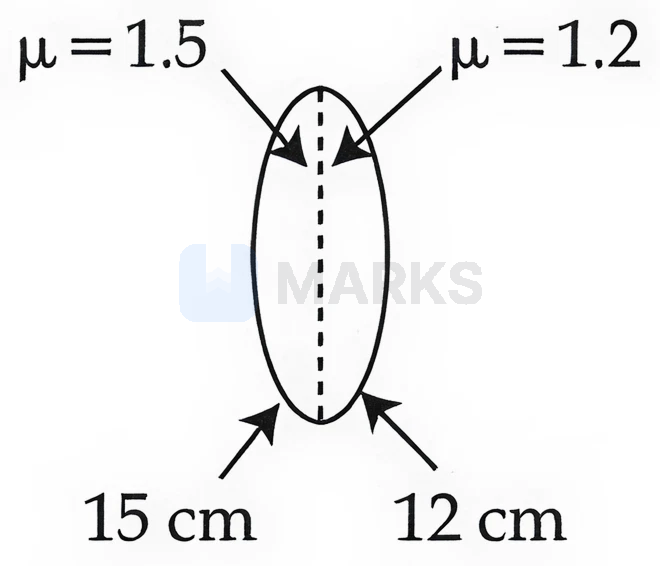
A biconvex lens is formed by using two thin planoconvex lenses, as shown in the figure. The refractive index and radius of curved surfaces are also mentioned in figure. When an object is placed on the left side of lens at a distance of 30 cm from the biconvex lens, the magnification of the image will be :
(A)
2
(B)
+2.5
(C)
2.5
(D)
+2
Show answer & solution
Verified Answer & Solution Locked
Sign in to your free student account to reveal verified answers, instant hints, and detailed explanations.
Sign in to view
Q2.

A concave-convex lens of refractive index 1.5 and the radii of curvature of its surfaces are 30 cm and 20 cm , respectively. The concave surface is upwards and is filled with a liquid of refractive index 1.3. The focal length of the liquid-glass combination will be

(A)
$\frac{500}{11} \mathrm{~cm}$
(B)
$\frac{800}{11} \mathrm{~cm}$
(C)
$\frac{700}{11} \mathrm{~cm}$
(D)
$\frac{600}{11} \mathrm{~cm}$
Show answer & solution
Verified Answer & Solution Locked
Sign in to your free student account to reveal verified answers, instant hints, and detailed explanations.
Sign in to view
Protected Questions

Unlock All 239 Questions in Ray Optics

Log in or sign up free to access every question with complete solutions, create chapter practice tests, and track your performance.

Sign up free to access all 239 questions

Unlock every Ray Optics question, generate papers, and practice at your own pace.